Real world learnings to get you thinking

Jay Park Jay Park

When the Knee Speaks for the Whole Body

Lately, I’ve been deepening my work with Anatomy in Motion, and this week I joined another session in their Phase 5 Mastery series—this time with a special focus on the knee.

Lately, I’ve been deepening my work with Anatomy in Motion, and this week I joined another session in their Phase 5 Mastery series—this time with a special focus on the knee.

The knee is an interesting place to spend time. It’s caught between the foot and the hip, influenced by everything above and below it, and often where the “noise” shows up first

Whether we’re talking about skiing, running, or simply walking through daily life, it’s worth stepping back and asking some better questions about what the knee is actually doing—and what might be driving what we feel there.

Is the knee the problem, or the outcome?

In some cases, “knee issues” are actually the effects of what’s happening at the foot, hip, or even higher up the chain.

• How are the foot bones moving to meet the ground?

• What options does this then give the femur and hip to rotate, load, and share force?

• How are the pelvis and spine influencing what the leg (and foot) can do, i.e. are they supporting friends or interfering?

The knee often becomes the place where reduced options elsewhere finally show themselves. It’s worth asking:

Is the knee really the driver of the problem—or just where the noise is showing up?

The knee isn’t just a simple hinge

It’s common to think of the knee as a basic hinge joint, like a door swinging open and closed. But that picture is incomplete.

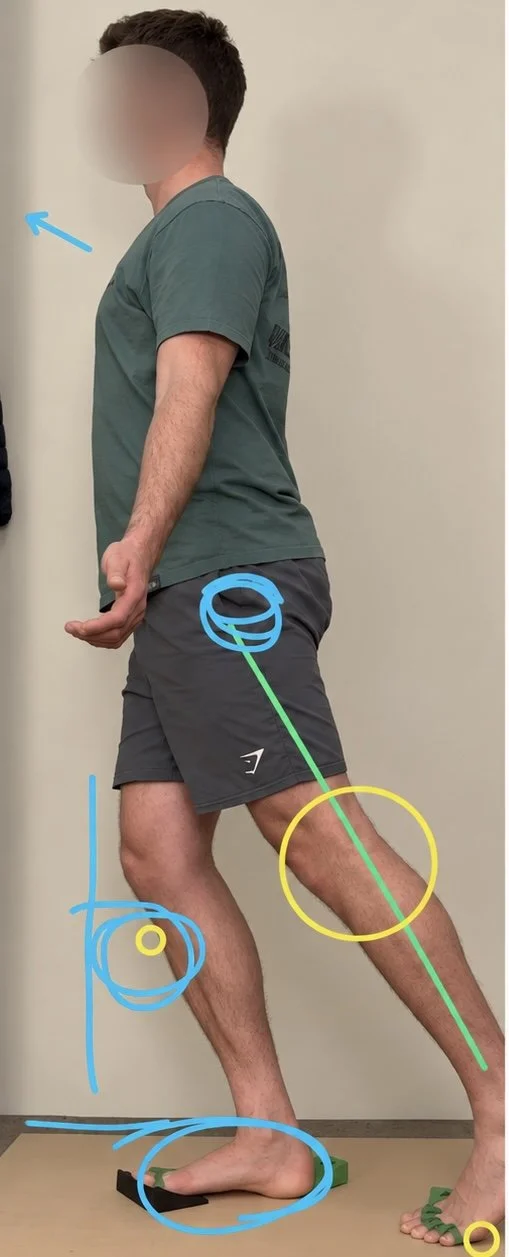
A more accurate image is this: The distal end of the femur glides and rotates along the tibial plateau.

When we coach or cue knee bend with this glide and rotation in mind, something interesting happens. People often feel:

• A more integrated connection between the foot, knee, and hip

• Less “isolated” effort at the knee and more shared work across the whole leg

• Tissues lengthening (or shortening) in response to structures (bones) moving

(For skiers in particular, this might shift how you see “flexing your knees”.)

Foot–femur relationships matter

The specific way—and the degree to which—the foot and femur relate to each other, both at rest and in motion, matters a lot.

Those relationships can:

• Increase or decrease the load on structures like the ACL or medial meniscus

• Change how well we absorb and redirect force

• Influence whether certain movement patterns feel fluid or fragile 

Change the way the foot and femur communicate with each other, and the story at the knee can change as well.

Ski boots also change the equation; it’s worth noting how this external constraint affects the foot-femur relationship and sometimes requires the hip to do more work to achieve similar outcomes (rotation, pressure management, and edge control).

 Additionally, if the relationships within your body are less than optimal, a ski boot can place additional load on structures and tissues already under tension or compression, thereby increasing risk factors. 

When one knee won’t straighten

Another pattern that often appears: one knee doesn’t fully straighten.

If, for example, your right leg can straighten easily and your left one can’t, you’re not just dealing with a local knee quirk—you’re likely building a full-body bias around it.

Over time, that can look like:

• Favouring the left suspension or midstance (a more bent, shock-absorbing position)

• Consistently pushing off the right leg more than the left, because it’s the “easier,” more available straightening side

• Subtle but persistent asymmetry in gait, stance, and weight shift—even if everything looks “okay” at a glance

• In essence, this equates to one foot on the gas and one on the brake

You don’t want to be left living in a knee that won’t straighten. Restoring options for both knees—both to bend and to straighten—gives the whole system more ways to share load, adapt, and move without one side always doing the heavy lifting.

Zooming out

What I’ve shared here is the broad strokes version of a much deeper dive we explored in the webinar: knee mechanics, injury mechanisms, spinal relationships, and applied progressions.

If you’re dealing with persistent knee discomfort—on snow or off—or you’re simply curious about how a more whole-body view of movement might change your knee story, I’d love to explore that with you.

(Shout to Gary Ward for the fantastic knee webinar.)

Read More
Jay Park Jay Park

Building a Better Push

As I began my second Anatomy in Motion mentorship, I reached out to a friend and long-time osteopath at the Canadian Sport Institute Alberta to see if he knew an athlete who…

As I began my second Anatomy in Motion mentorship, I reached out to a friend and long-time osteopath at the Canadian Sport Institute Alberta to see if he knew an athlete who might be interested in serving as a case study.

He connected me with Taylor Austin, a former football player and now a driver with the Canadian National Bobsleigh Team.

After I explained what being a case study would involve, Taylor didn’t hesitate to jump in as one of my “guinea pigs.”

This case study is a summary of our work together since April 2025. It includes my initial assessment — from injury history, current discomforts, and performance limitations to resting and dynamic posture, gait, sprinting, and sled-push mechanics — as well as adjustments and considerations for his current strength and conditioning program.

There’s more to come as we keep refining how his body moves, adapts, and performs under load — both in the gym and on the ice.

Follow Taylor on Instagram @TaylorIIAustin as he continues his journey toward the 2026 Olympics in Milano Cortina, Italy.

Read More
Jay Park Jay Park

How Your Brain Builds Your Day: Movement, Meaning, and Your Body Budget

Your thoughts, emotions, and overall experience are a combination of your remembered past and your sensory present. From that “place,” you decide what to do next – your actions, your behaviour, your next move.

Your day starts in your brain.

Your thoughts, emotions, and overall experience are a combination of your remembered past and your sensory present. From that “place,” you decide what to do next – your actions, your behaviour, your next move.

This way of thinking is rooted in the Theory of Constructed Emotion by neuroscientist and psychologist Lisa Feldman Barrett.

Lately, I’ve been thinking more and more about Lisa’s work and how it shows up in actual daily life – in coaching, in movement, in skiing, and in all the “in-between” moments we usually ignore.

Before I start drawing lines between her work and skiing/movement, it’s worth framing the landscape a bit.

Classical brain stories vs what’s really happening

Broadly speaking, there are two camps in neuroscience.

The first is what I’ll call “classical neuroscience.” This is the stuff that shows up in everyday language: the “lizard brain,” the battle between rational and emotional thinking, the idea of being “triggered” as if emotions are buttons that get pushed. These concepts are everywhere – in pop psych books, coaching language, and Instagram quotes.

The problem? They’re mostly wrong. Classical theories might be tidy and familiar, but they don’t match what we now know about how the brain actually works. Despite still being everywhere in 2025, a lot of this story is a myth. That familiar “head vs heart” narrative is another version that feels intuitive, but doesn’t really match how the brain actually works.

So if we’ve all been fed a batch of comforting-but-misleading brain stories, what’s really going on “under the hood,” as Lisa likes to say?

This is where the Theory of Constructed Emotion comes in. It has several deeply researched components. One key idea, as I said at the start, is that your thoughts, emotions, and behaviour are a combination of your remembered past and your sensory present.

What does that mean in real life?

Piece one: Your remembered past

Let’s start with your remembered past.

Every thought, emotion, and action you take is shaped by all of your life experiences, from the moment you’re born to right now. Your brain is literally built from the sounds, environments, words, family dynamics, music, movies, friendships, pain, and everything else you’ve lived through. From all of this input, your brain builds predictive wiring patterns and “concepts” – its best guesses about what things mean and what should happen next.

Piece two: Your sensory present

So that’s piece one. Piece two is your sensory present.

Your sensory present is also a combination – it comes from both your external and internal senses. Externally, your brain is taking in what you’re seeing, hearing, and feeling in the environment. Internally, it’s tracking what’s going on inside your body: your breathing, heart rate, muscle tension, digestion, fatigue, and so on.

All of this mixes into a kind of present-moment “report” – what Lisa would call your affect – that your brain reads as more or less pleasant or unpleasant, and more or less activated or tired.

When you mix this sensory present with your remembered past, your brain is constructing concepts (old or new) that precede and shape your next thought, emotion, behaviour, or action.

The hidden accountant: your body budget (on and off on snow)

There’s one more important piece to touch on here: your body budget – or, more scientifically, allostasis.

Most people (including me, before diving into Lisa’s work) would say that one of your brain’s main jobs is “thinking.”

It turns out that’s another myth. Let me explain.

If we consider that one of our primary jobs as humans is simply to survive, then one of the brain’s biggest roles is to make sure that happens, day in and day out. That means managing the basics: enough sleep, decent food, movement, social contact, and everything else that keeps the body running. In other words, the brain is constantly working to manage and optimise our physiology – our body budget.

When you look at it this way, “thinking” actually takes a back seat to physiology in the overall survival picture. It’s not that thoughts don’t matter, but in the larger architecture of the brain, they’re secondary to the ongoing, behind-the-scenes work of regulating your body budget.

Are you really “triggered”? Predictions, not buttons

Let’s go back to that idea of being triggered for a second.

Since, through the combination of our remembered past and sensory present, we construct our experience, we’re also constructing our thoughts, emotions, and reactions. So while it can really seem, on the surface, like you’re being triggered by an event, what’s actually happening is that your brain is predicting and constructing that moment using its existing wiring. These constructions happen so fast that they feel like an automatic “response,” rather than something your brain is actively building in real time.

And when you add your predictions to your body budget, you get the source of the meaning you give a thought, an emotion, or an experience. In simple terms: meaning = predictions + body budget.

For example, if you slept like crap and had a fight with someone last night, your body budget is already in the red. Your brain is going to read that physiology differently, and snap — it’s more likely to predict threat, criticism, or “here we go again,” even in a fairly neutral moment.

Or flip it: maybe you’re starting a new job or trying a new sport. Your brain immediately asks, “What is this like that we’ve done before?” and pulls from old files — a similar sport or movement, past fears from trying something new, old embarrassments from another job, or the familiar “not good enough stories” — to build its best guess of what’s happening now.

And in both cases, the “meaning” of the moment isn’t baked into the situation itself — it’s coming from that mix of predictions and constructions + body budget.

So what does this have to do with movement and skiing?

Every squat, push-up, carved turn, or bump run — and every “good” or “off” day in your body — is your predictive brain and your body budget in real time.

Beginner skier: two very different days on the same slope

Now let’s put all of the above into a practical, real-world context.

Beginner skier. They’ve never been on snow – maybe they’ve never even seen a ski hill in person. Their brain has almost no “file” to match this situation; the prediction error is high, and their body budget is taxed quickly. In simple terms, what they expect and what they feel don’t line up, so their system has to work harder. Heart rate climbs, muscles brace, everything feels loud and intense.

Another beginner, with some past experiences in similar environments or a better body budget that day (they slept well, ate, and aren’t already stressed), might process the same day’s novelty with more curiosity than fear. Whether that first day on snow feels terrifying or weird-but-exciting is still happening on the same slope – and a lot of that difference in experience comes from their brain and body budget, not just from the hill itself.

What this means for coaching

From a coaching standpoint, we start with awareness. Every client, athlete, or student arrives with a unique body-budget baseline. Beyond basic check-ins about sleep, hydration, and stress, the real work is learning to read those baselines as real brain–body signals — with wide-ranging physical, mental, and emotional effects.

It also helps to really acknowledge that each person’s predictive wiring is present in everything they do. It’s running behind the scenes in real time — sometimes giving them an edge when they’re learning something new, and sometimes getting in the way of new skill acquisition or performance.

Zooming out a little, I’m reminded of a part of the CSIA’s ski-teaching methodology: “know your learner.” It’s a simple idea, but when you layer in predictions, concepts, and body budget, those three words take on new depth. The questions you ask your student or client might look the same, but the reasoning behind them – and the answers you hear – should guide that day’s structure and experience, and help define what “success” and “performance” look like for that day.

What this means for your own movement and skiing

From a movement standpoint, if you look at injury history through Lisa’s lens, you start to see a two-way conversation between biomechanics (how you stand, move, and load joints) and your brain’s interpretation of those positions: are these familiar? Are they safe? Does this feel good or just weird? Every person will have an interpretation that’s unique to them, so what lands for one person may fall flat for another, because no two people have the same body budget or remembered past. You also see this play out in movement sessions and on snow, where you prescribe a movement exercise or specific drill and it just doesn’t click. So your next action might be an investigative question, a reassessment, a different cue, or trying a totally different movement.

Takeaways for your next ski day and beyond

On snow or in life, your brain is always building your day from the inside out. If you can work with your predictions and your body budget, you change the story you’re skiing inside.

This article just scratches the surface of neuroscience and constructed emotion. Check out Lisa Feldman Barrett’s website to dive deeper.

Read More